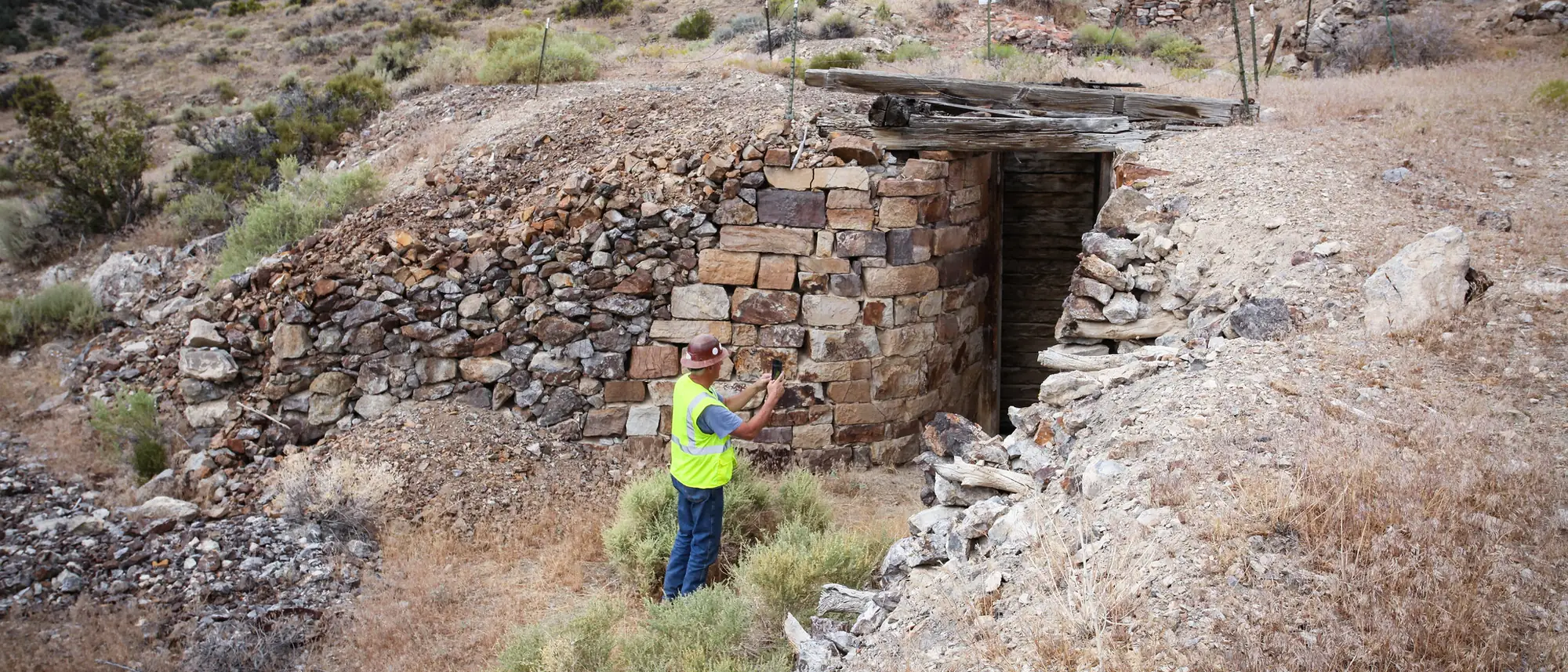
A dry-stone portal to a historic mine adit on a Nevada hillside, a worker in a hard hat beside it
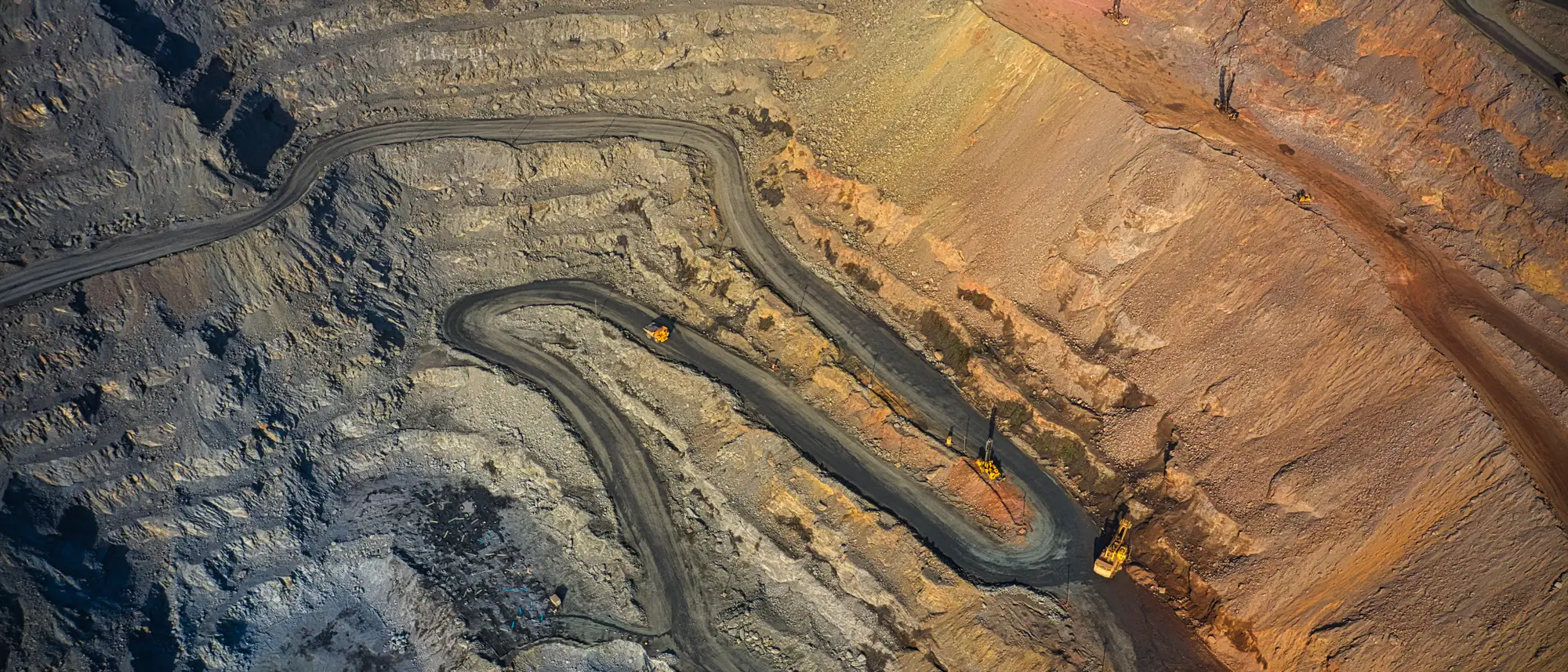
Aerial view of an open-pit mine's benches, haul roads switchbacking down through coloured ore

Four centuries

America was a metals country before it was a country

The first large industrial works in the English colonies was not a mill or a shipyard. It was an ironworks. Everything that followed — the rushes, the railroads, the wire that carried electricity, the aluminum that flew — came out of American ground and was made into metal on American soil.

Historic adit portal, Nevada

Open-pit benches and haul roads

1619 – 1775

The furnace comes first

The Virginia Company put ironworkers on Falling Creek near present-day Richmond in 1619. In March 1622 Powhatan warriors destroyed it, killed twenty-seven people and threw the tools in the creek. Whether it ever produced marketable iron is still not settled.

The works that stuck was Saugus, Massachusetts, from 1646 — a blast furnace, a forge, and a rolling and slitting mill that was one of perhaps a dozen in the entire seventeenth-century world. It ran on 35 skilled men, local farmers doing seasonal work, and Scottish prisoners taken at Dunbar who were paid in food and shelter. It made axes, saws, hoes, nails, pots and kettles — the hardware a settlement cannot exist without.

It failed. Not for want of ore or skill, but in litigation: the manager was removed in 1653, investors sued, workers petitioned for back wages they never got, and ironmaking ended around 1668–1670. Its real output was people. Saugus men — the Leonards, the Jenkses, the Pinnions — went out and started ironworks across the northeast. Pennsylvania built nearly fifty furnaces and forges between 1716 and 1756, and had roughly 200 charcoal furnaces by 1840.

By 1776, on a widely cited estimate of about 30,000 tons a year, the colonies were making roughly as much iron as Britain itself — which would have put them third in the world, behind Sweden and Russia. Parliament had tried to stop exactly that with the Iron Act of 1750, which banned new colonial slitting mills, plating forges and steel furnaces. It was barely enforced: no works is known to have been shut under it, and New Jersey's royal governor visited an illegal slitting mill and left declaring the report groundless.
1807 – 1858

Lead, copper, gold — and the first federal mineral policy

Congress reserved mineral lands from public sale in 1807 and put them under federal management — the first American mineral policy, a full sixty-five years before the law that still governs hardrock mining today. The War Department took charge of the lead lands in 1821 and issued its first Galena lease in September 1822, with lessees paying the government a royalty in lead itself — one-tenth of what they smelted under the early system, cut to six percent by the 1830s.

It worked, then it broke. Upper Mississippi output went from five million pounds in 1827 to more than thirteen million in 1829. By 1829 over 4,000 miners worked southwestern Wisconsin; the ones who dug into hillsides for shelter got the nickname that stuck to the state. Then smelters simply refused to pay rent, the agency collapsed, and Congress sold the land off in 1846.

Copper came next. Michigan's state geologist described the Keweenaw deposits in 1840; the Ojibwe ceded the land in the 1842 Treaty of La Pointe; the Cliff Mine opened in 1845 and returned $2.5 million to its investors. By 1849 the Keweenaw supplied 96 percent of all American copper, and it remained the leading US copper district until 1887. Before Butte, before Bingham, the wire for the telegraph and the trans-Atlantic cable came out of Michigan.

Michigan iron was found in September 1844 when surveyors watched their compass needles swing wildly. The state marker credits William Burt. It also records that an Ojibwe chief, Marji-Gesick, guided the Jackson prospectors to the ore — a credit routinely dropped from the popular telling.

And gold: North Carolina from 1799, Georgia from 1829, then California. James Marshall picked up a piece of metal on the American River on 24 January 1848. California's non-Indian population went from about 14,000 that year to roughly 223,000 by 1852.

1859 – 1884

The Comstock, and the rules that still apply

The silver and gold strikes near Virginia City in 1859 produced almost seven million tons of milled ore in twenty years. Virginia City and neighbouring Gold Hill held about 4,000 people in 1862 and some 25,000 by 1874.

What the Comstock really produced was engineering. The ore bodies were too wide and too soft to hold themselves up, so in 1860 Philipp Deidesheimer invented square-set timbering — interlocking timber cubes built up into the void as ore came out. Below the water table the workings flooded with hot water, so Adolph Sutro spent 1869 to 1878 driving a drainage tunnel through the mountain. By the time it was finished the mines were already deeper than the tunnel.

Nevada became a state on 31 October 1864, eight days before the presidential election. The constitution was telegraphed to Washington because the certified copies had not arrived — 16,543 words, seven hours on the wire, $4,313.27.

Then, on 10 May 1872, Grant signed the General Mining Act. It declared all valuable mineral deposits on federal land "free and open to exploration and purchase" by American citizens, at $5 an acre for a lode claim and $2.50 for placer ground. It codified the rules the western camps had already made for themselves. It is still the law. Hardrock mining on federal land is governed by it today — which is why it remains one of the most argued-over statutes in the country, criticised for charging no royalty and defended as the thing that makes high-risk exploration financeable.

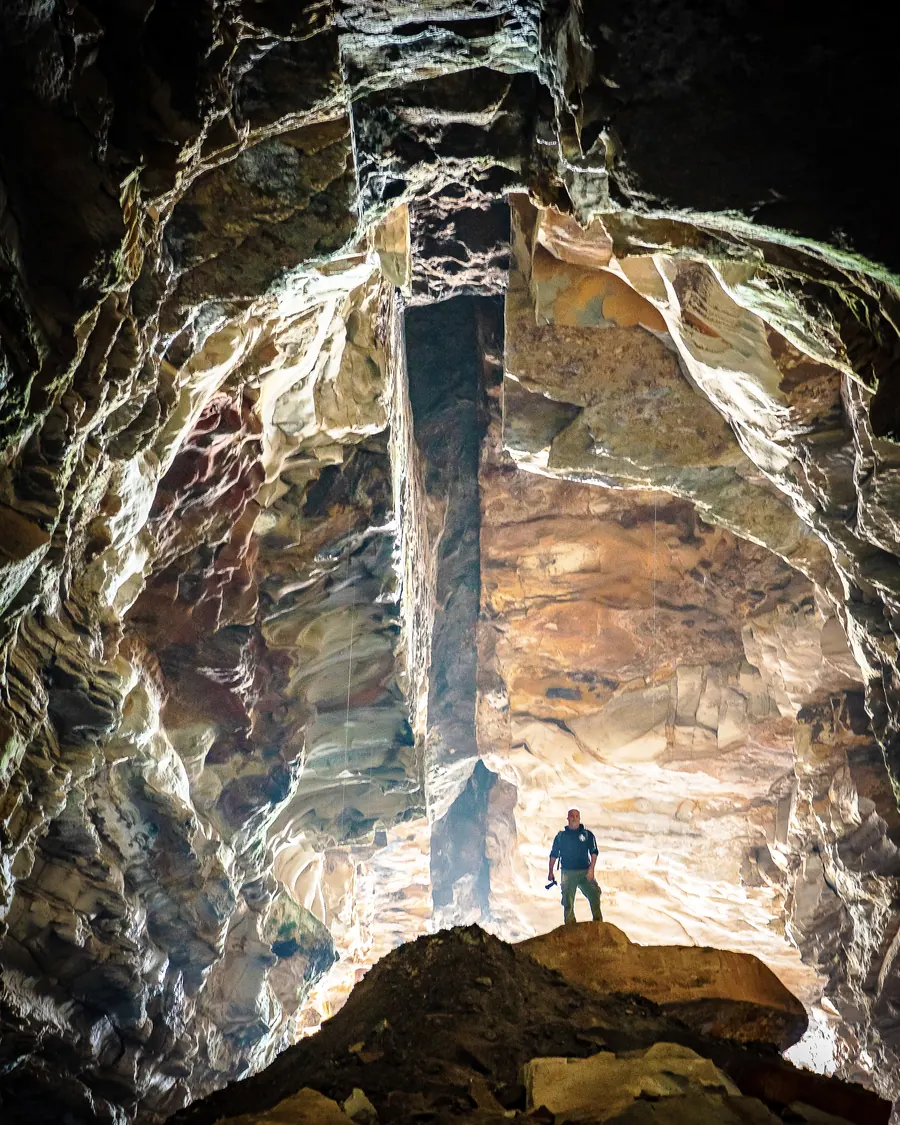
A worker dwarfed by a vast underground stope, mineral-streaked rock rising above
The scale the Comstock forced. Ore bodies too wide to hold themselves up are why square-set timbering had to be invented in 1860.

1890 – 1906

The American invention

Three things happened within fifteen years that made the United States the world's metals power.

The Mesabi Range. The Merritt brothers of Duluth spent sixteen years looking and found the Mountain Iron deposit in 1890; first shipment 1892. Mesabi ore was soft hematite lying near the surface, so steam shovels could load it straight into rail cars — the opposite of the hard lump ore mined underground back east. From 1892 to 1961 the Mesabi supplied more than half of all iron ore mined in the United States. The Merritts lost it all in the Panic of 1893 to a creditor named Rockefeller, who sold it on to Carnegie's people; it ended up inside U.S. Steel, which in 1901 became the first billion-dollar corporation in history.

Butte, Montana. Gold in 1864, silver in the 1870s, copper from 1883 — and copper was what mattered, because the age of electricity ran on copper wire. By 1910 Butte was producing more than a quarter of the world's copper from 125 mines. Some 21.5 billion pounds came out of that hill between 1880 and 2004.

Bingham Canyon. This is the one that changed mining everywhere. The conventional view was that the Oquirrh Mountains rock was worthless because it held only about two percent copper. In the late 1890s Daniel Jackling argued it could be mined at a profit anyway — if you moved enough of it, cheaply enough, with steam shovels, and concentrated it in bulk. He organised the Utah Copper Company in 1903 and proved it.

Before Jackling, an ore body was worth mining only if the ore was rich. After Jackling, grade could be traded against volume. Every large mine on earth descends from that idea, and it is American.

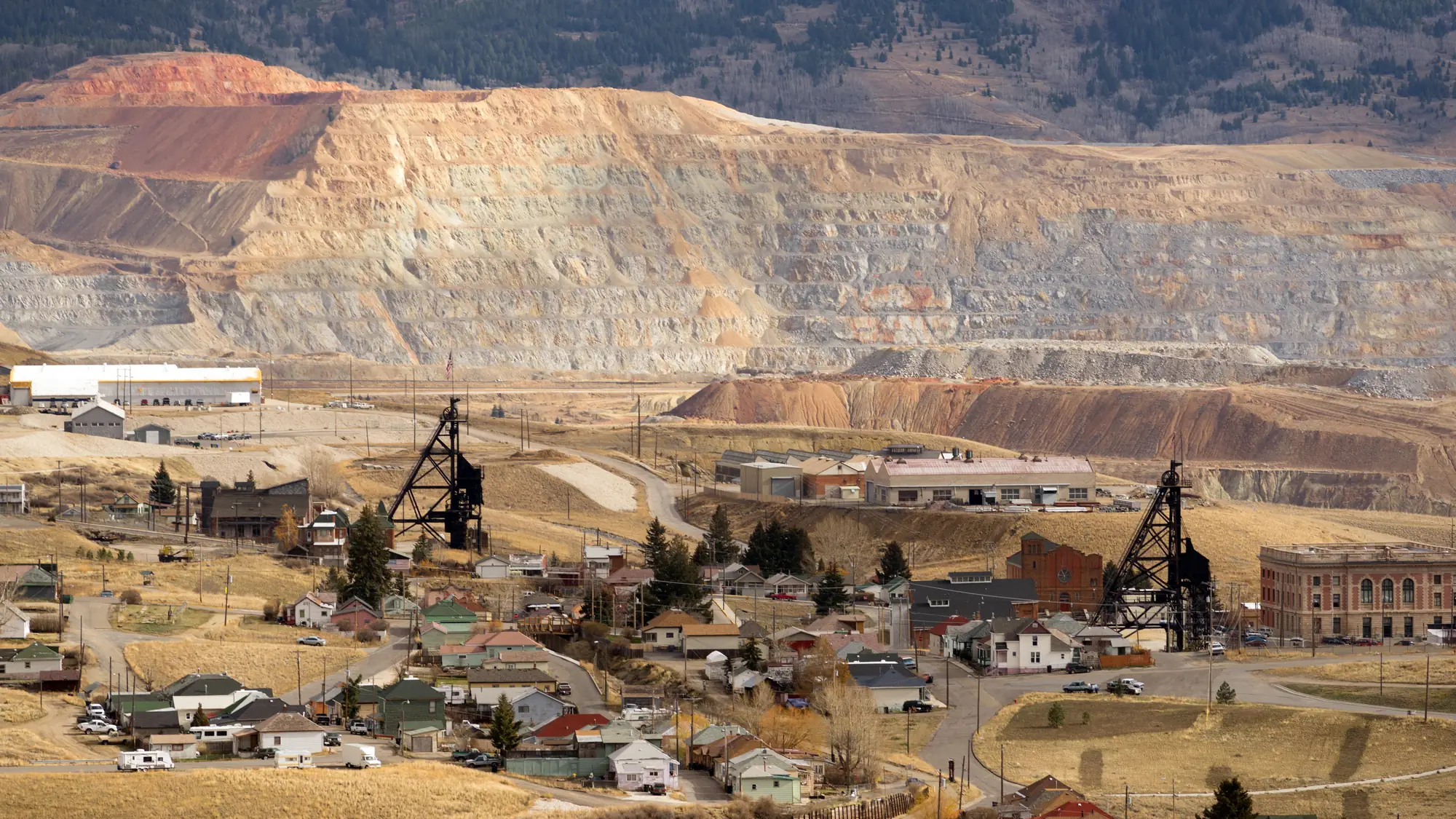
Butte, Montana: two black steel headframes standing over the town, the terraced Berkeley Pit rising behind
Butte, Montana. Two headframes still stand over the town, the Berkeley Pit terraced above it. Some 21.5 billion pounds of copper came out of that hill.

1886 – 1941

Aluminum follows the water

On 23 February 1886, a year out of Oberlin, Charles Martin Hall found that molten cryolite would dissolve aluminum oxide — and made his first globules of aluminum with homemade batteries in a woodshed. A French chemist, Paul Héroult, found the same thing the same year, which is why it carries both names.

Smelting aluminum is really the business of turning electricity into metal. It takes about 45,000 BTU per pound, and power can be 40 percent of the cost. So the smelters went wherever the current was cheapest: Niagara Falls in 1896, then the Tennessee Valley, then the Columbia River. Bonneville came online in 1938, Grand Coulee in 1941.

At full stretch the Pacific Northwest ran ten smelters, 11,000 workers and 3,150 average megawatts — 40 percent of US smelting capacity and six to seven percent of the world's. Electricity from Grand Coulee alone made the aluminum for roughly a third of the aircraft built in the Second World War.

That geography is also the explanation for what happened later. The industry was built on federal power at federal prices. When those prices rose, the smelters had nothing else holding them in place.

1942 – 1945

The arsenal

The War Production Board was created on 16 January 1942. What American mining and metals did in the next three years is the strongest argument this site has, and it is worth being precise about.

Steel ingot output had already gone from 52.8 million net tons in 1939 to 82.9 million in 1941, and rated capacity approached 93 million tons by the end of 1942. Aluminum capacity went from 917 million pounds a year before Pearl Harbor to roughly 2.3 billion pounds twelve months later. Magnesium went from 42 million pounds a year to 260 million. Scrap drives alone yielded more than 600,000 tons of refined copper in 1942. One mine, Bingham Canyon, supplied about 30 percent of the copper used by the Allies.

When Japan took 90 percent of the world's natural rubber, the country built a synthetic rubber industry from nothing: 231 tons in 1941, 2,241 tons in 1942, roughly 920,000 tons a year by 1945. Fifty-one plants, recommended by a committee that reported within a month of being appointed.

The same government shut down its own gold industry to get at the labour. Limitation Order L-208, issued 8 October 1942, closed the gold mines. It did not work: the board expected to move 4,000–5,000 men to copper and moved about a hundred skilled miners permanently, while mines collapsed in the dark and most never came back.

And one fact belongs here for honesty's sake. The uranium for the Manhattan Project was not American. Roughly two-thirds came from the Shinkolobwe mine in the Belgian Congo — ore thousands of times richer than anything in the western United States, sitting in a Staten Island warehouse since 1940. Even at the height of American industrial power, the critical material came from somewhere else.

1946 – 1980

High water

The postwar decades are when everything peaked, and the dates are worth knowing because they are the benchmark every later number is measured against.

Steel peaked in 1973 at 137 million metric tons, when the United States was the world's leading producer. Bethlehem Steel alone made 23.7 million tons of raw steel that year and shipped 16.3 million tons of finished steel, both company records. Primary aluminum peaked in 1980 at 4.65 million metric tons from more than thirty smelters. Sixteen copper smelters were running in the late 1970s. The National Defense Stockpile, built after Korea, would peak in 1989 holding $9.6 billion of material across 91 line items.

Meanwhile the country poured itself a road system. The Interstate Highway System embodies roughly 1.5 billion metric tons of aggregate, 48 million tons of cement and 6 million tons of steel — more than half of all the sand, gravel and crushed stone used for construction in the United States in 2005, to put it in scale. The Bureau of Public Roads described the excavation in 1961 as moving enough material to bury Connecticut knee-deep in dirt.

Minnesota's ore also ran out and was reinvented. When the natural hematite thinned after the war, Dr. Edward Davis at the University of Minnesota worked out how to mine and pellet taconite — a rock nobody had previously considered ore. Minnesota voters approved the Taconite Amendment in 1964 with 86 percent in favour, and within a decade taconite had replaced direct-shipping ore entirely. It is still what the Mesabi ships today.

1981 – today

The middle falls out

Copper broke first. Prices fell more than half between 1980 and 1984. US mine production went from over 1.5 million tonnes in 1981 to just over 1 million in 1983. Employment across mines, mills, smelters and refineries fell 41 percent in four years. Bingham Canyon employed 7,000 people in 1980; when it reopened in 1987 it carried 2,371 on the payroll including modernisation crews, with 1,800 expected once it reached full production.

Then the smelters went. Of the sixteen US copper smelters running in the late 1970s, eight closed permanently by the mid-1980s. The technology that rescued the surviving mines finished the rest: solvent extraction and electrowinning produce cathode copper from leach solution for about thirty cents a pound and skip the smelter altogether.

The honest account of why is mixed, and worth stating plainly because the simple version gets challenged. The Clean Air Act did require 90 percent control of sulfur oxide emissions, and older smelters were not worth upgrading to meet it. But the Office of Technology Assessment put the whole cost of environmental compliance at 10 to 15 cents a pound — real money, and small next to a copper price that had halved. Regulation raised the cost of keeping an obsolete plant alive. The market decided which ones were worth the money.

Steel went through the same decade differently. Imports hit a record 41.5 million tons in 1998; Bethlehem, Republic, Wheeling Pittsburgh, Weirton and National went bankrupt, LTV was liquidated, and more than 100,000 retired steelworkers lost their health benefits. But American steel did not disappear — it changed technology. In 2002 electric arc furnaces melting scrap overtook blast furnaces for the first time. By 2019 they were about 70 percent of American steel. That is what an industry looks like when it reinvents itself rather than leaving.

Aluminum had no such reinvention. Twenty-three smelters run by twelve companies in 2000 became six smelters run by three companies by 2021, and the United States fell under two percent of world primary production. Copper smelting is down to two plants. That is the gap this site exists to close.

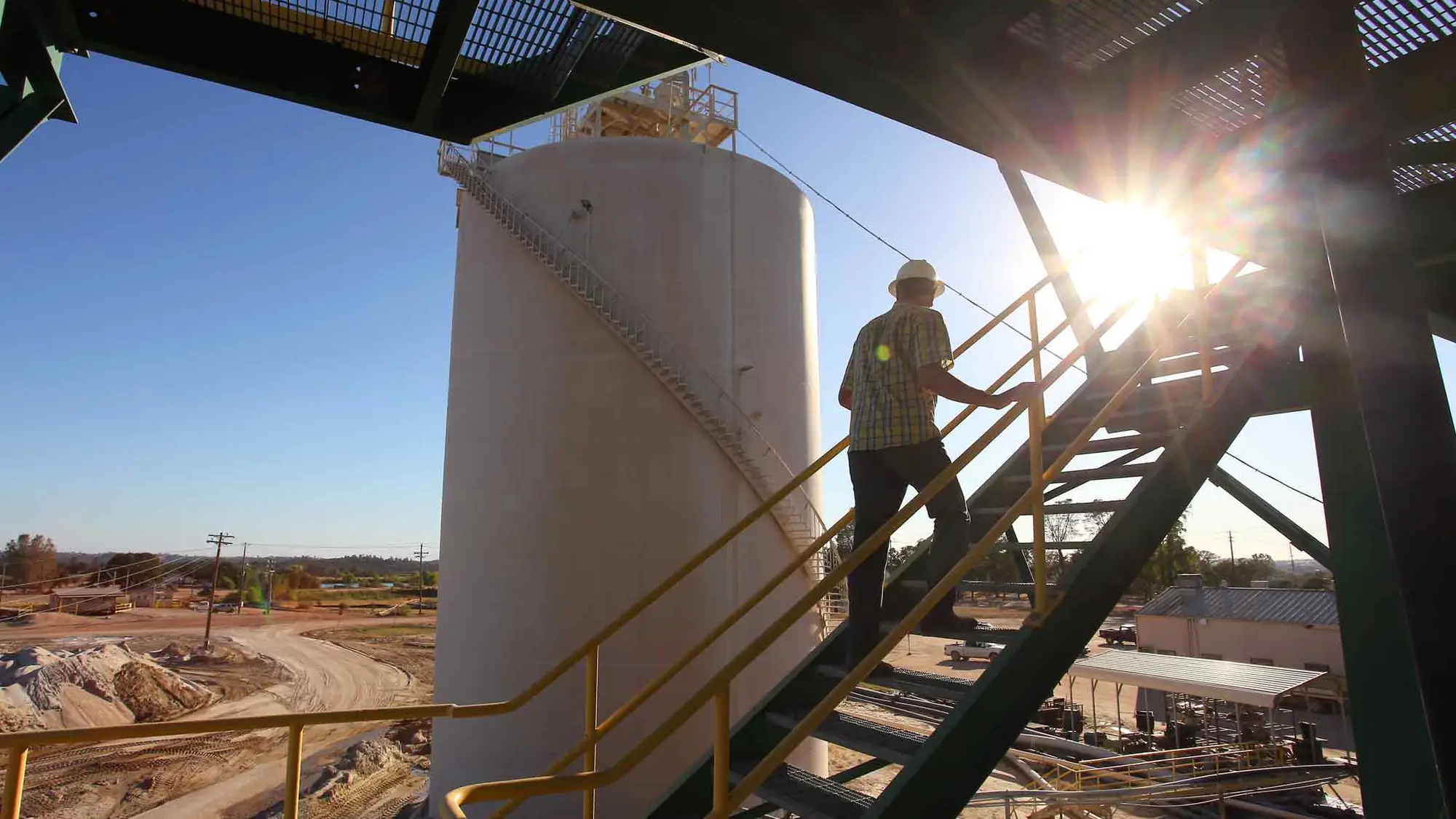
A worker climbing an external stair at a processing plant, sun flaring behind the structure
What is left is worth keeping warm. American processing capacity is now small enough that every operating plant counts.

What it cost

The part usually left out

A case for American mining that skips this part is not worth making, and will not survive the first person who checks. The industry that built the country also killed a great many of the people who worked in it and left ground that is still being cleaned up. Both things are the record.

103,000
American miners killed at work between 1911 and 1997
CDC / MMWR
329 → 25
mining deaths per 100,000 workers, 1911–15 compared with 1996–97 — a 37-fold reduction
CDC / MMWR
362
killed at Monongah in December 1907, the disaster that forced Congress to create the Bureau of Mines in 1910. Unofficial estimates exceed 500
MSHA · CDC
1,186
men rounded up at gunpoint in Bisbee, Arizona on 12 July 1917 and shipped into the New Mexico desert. No one was convicted
University of Arizona
1.5 billion yd³
of gravel washed away by hydraulic mining in the Sierra Nevada, along with some 10 million pounds of mercury lost to the environment
USGS FS 2005-3014
1884
the Sawyer decision ended hydraulic mining in the Sierra after finding 15,000 acres of farmland buried — America's first great environmental ruling, and it came out of mining
Woodruff v. North Bloomfield
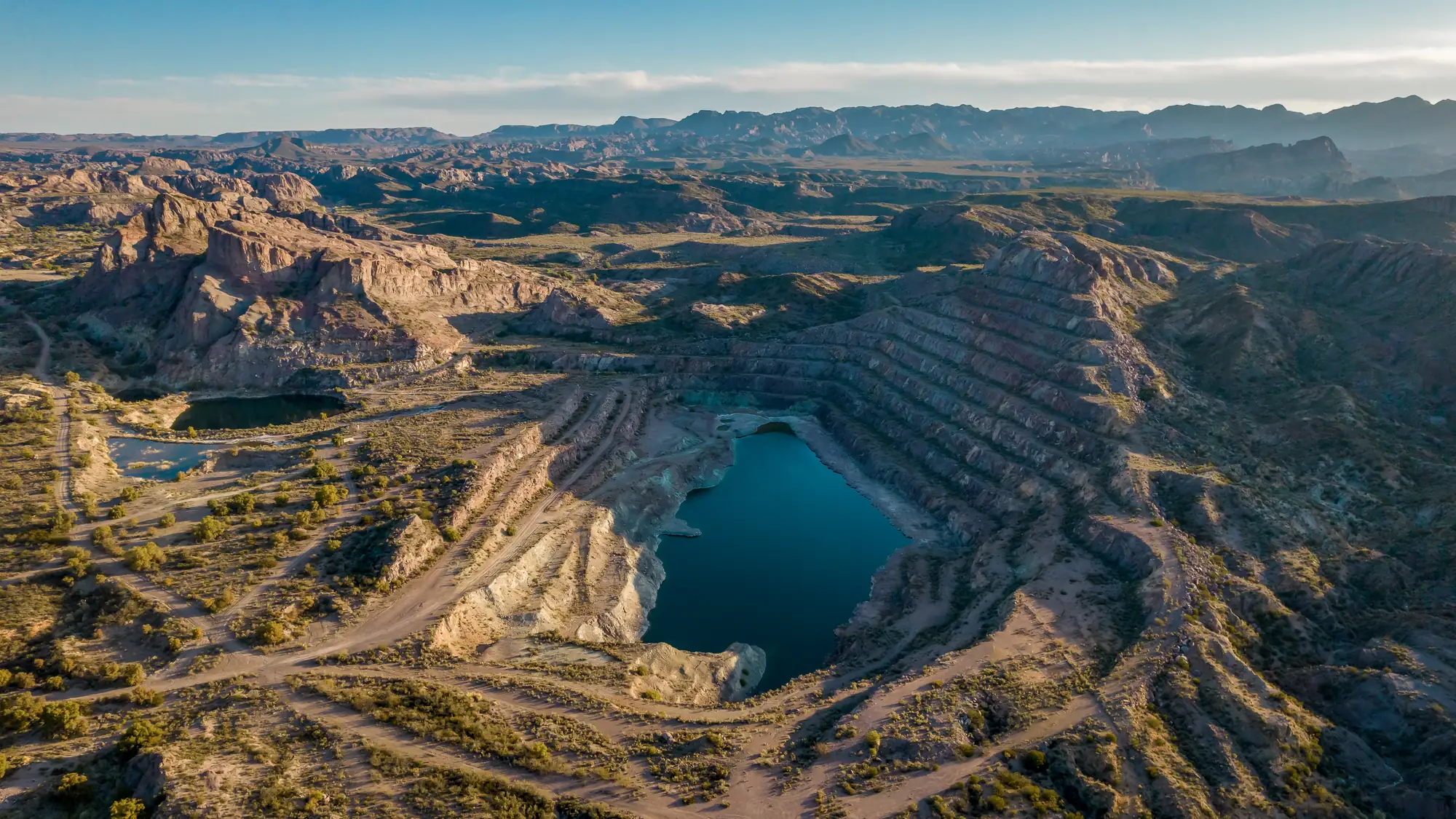
Aerial view of a terraced open pit filled with a deep blue lake
A worked-out pit fills with water. Reclamation is part of the cost, and part of the argument for mining where a regulator can reach the operator.

The names matter too. Ludlow, Colorado, April 1914 — National Guardsmen aligned with the coal company killed twenty-one people, among them eleven children and two women who suffocated in a cellar beneath a burning tent. The congressional investigation that followed helped produce child labour laws and the eight-hour day. Blair Mountain, West Virginia, 1921 — thousands of miners marched sixty miles in what the Park Service calls the largest pitched battle in American labour history and the largest insurrection on US soil since the Civil War.

And the towns. Hibbing, Minnesota moved 188 buildings two miles south on logs and horses between 1919 and 1921 because the ore was underneath. Anaconda's smelter closed in 1980 and left a 300-square-mile Superfund site. Silver Bow County's population peaked at 60,313 in 1920 and is barely half that now. Bisbee lost its mine in 1975, watched its housing market collapse, and was bought up cheap by artists and retirees who turned it into a heritage town.

None of this is an argument against mining. It is the argument for doing it here, under American law, where a court can order a company to stop, a regulator can measure the stack, and the people who bear the cost can vote. Ore processed in a country with none of that is not cleaner. It is just further away.

Every one of these was a decision

Read the four hundred years together and one thing stands out: nothing in this story was inevitable.

Saugus failed in a lawsuit, not for want of ore. The lead-lease system collapsed because smelters stopped paying and nobody made them. The aluminum industry went to the Columbia River because the federal government sold power cheap, and left when the price went up. Eight copper smelters closed in five years because copper fell by half and nobody was paid to keep the capacity warm. Taconite exists because a university professor and a state referendum decided the Mesabi would not die.

The one time this country decided it needed a metals industry on a deadline, it built one in thirty-six months. That is the actual precedent.

See what is still running